
.png)
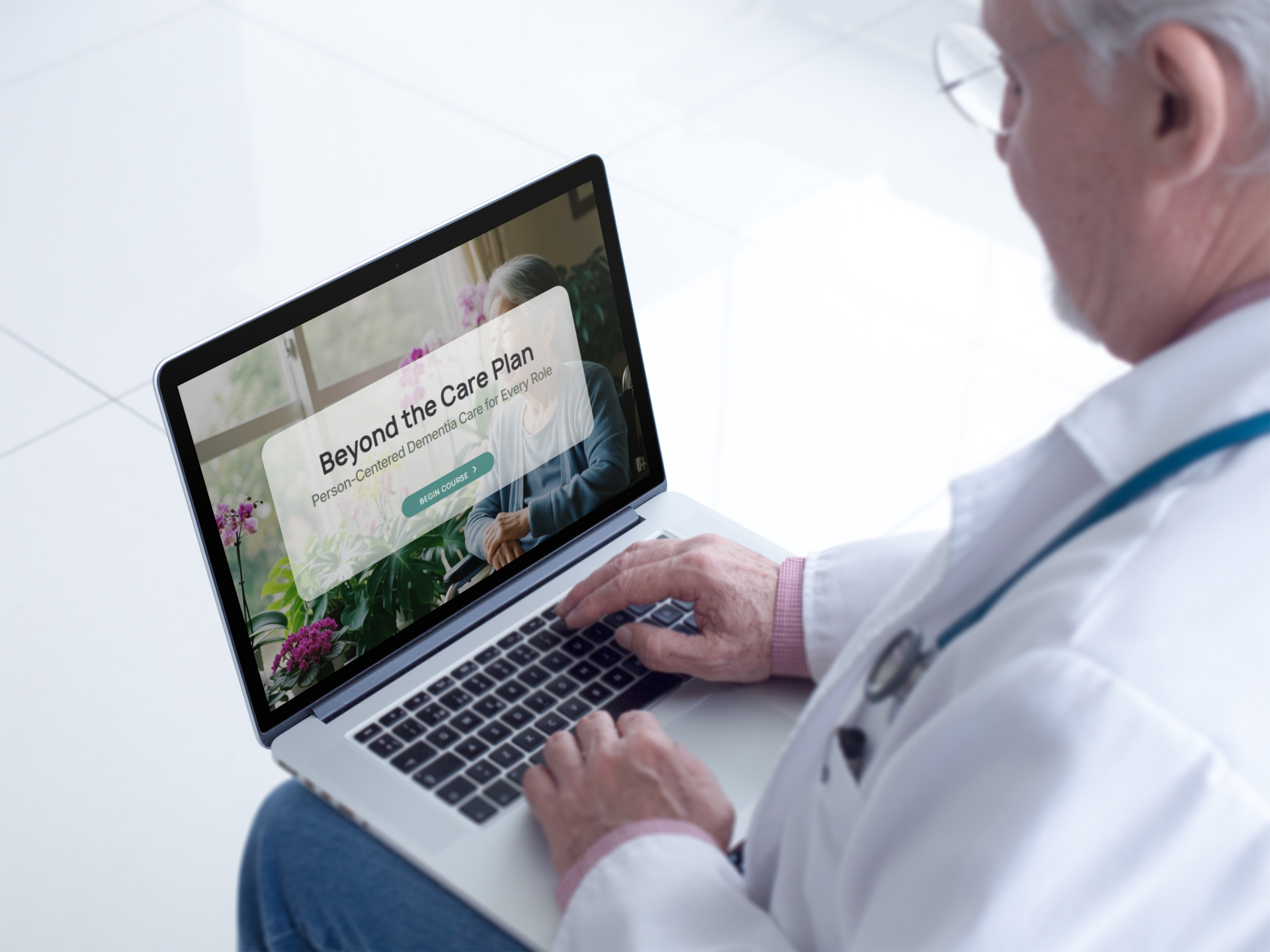
A modern take on traditional eLearning, featuring a liquid glass design.

In senior living, care plans often exist—but their meaning can get lost in the pace of daily work.
Staff outside of clinical roles may view care plans as something written about residents rather than something lived with them. For residents with dementia, this gap matters deeply. When care becomes task-driven instead of person-centered, distress increases, trust erodes, and the individual behind the diagnosis disappears.
This course needed to:
The challenge was not teaching what dementia is, but helping staff understand how their everyday actions shape a resident’s sense of safety, dignity, and belonging.
This project was designed for a mixed-role senior living workforce, including nursing, dining, housekeeping, activities, maintenance, and front-line staff.
Key learner realities:
The learning needed to feel:
Rather than a traditional instructional flow, this course required a reflective, experience-centered approach—one that invited learners to slow down, notice, and reconnect with why their work matters.
This course was approached as a learning experience design problem rooted in empathy, not information transfer.
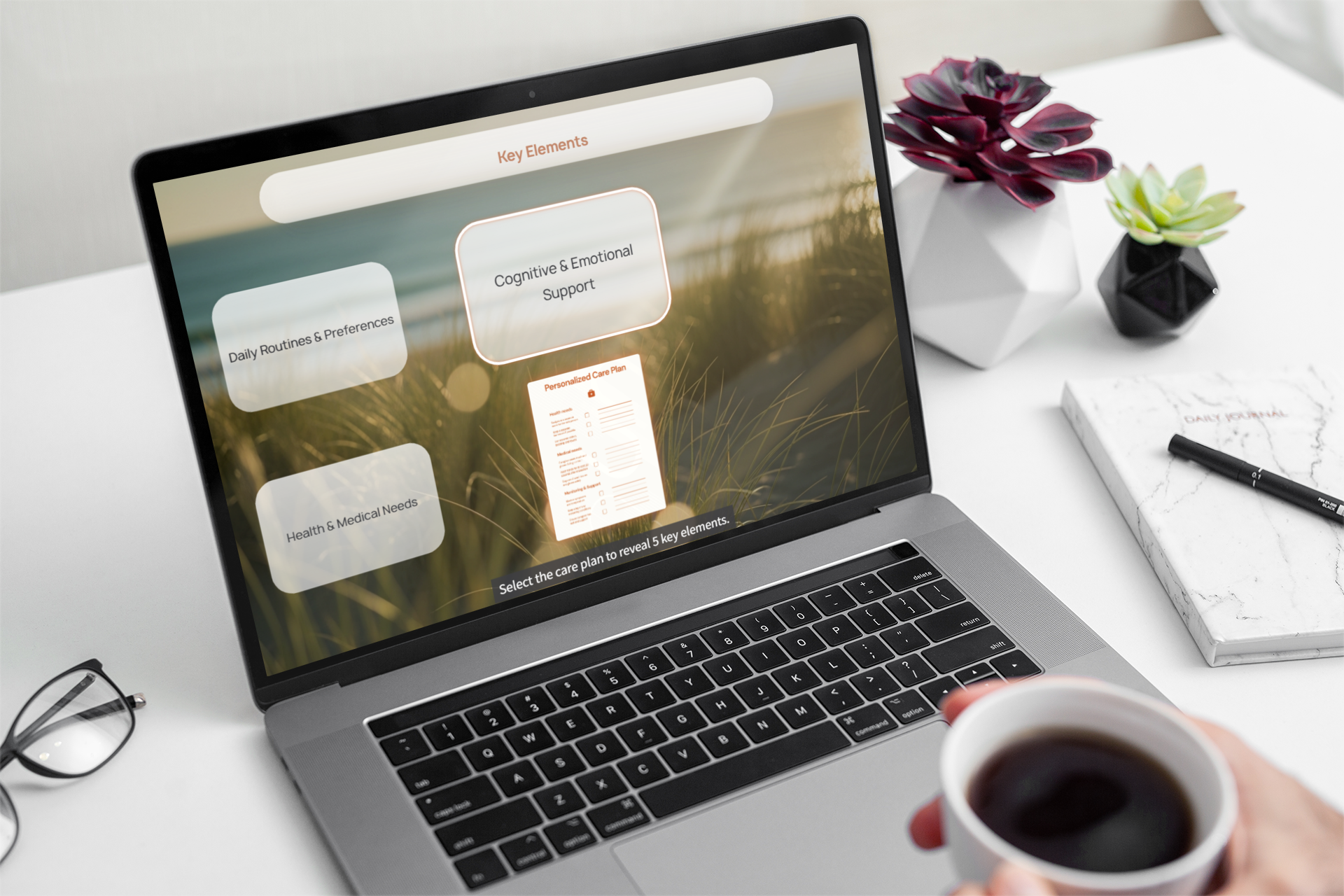
From a cognitive standpoint, I applied Mayer’s Multimedia Principles to support clarity and emotional regulation. Content was intentionally segmented into short, conceptually coherent modules, allowing learners to process emotionally heavy material without overload. Signaling was used to highlight what truly matters—key elements of person-centered care, moments of reflection, and practical takeaways—while the coherence principle guided restraint, removing anything that distracted from the human core of the message.
The client required on-screen text to remain visible whenever narration was present. While this conflicts with Mayer’s modality and redundancy principles, the constraint was handled deliberately: text was tightly aligned to spoken language, pared down to essential phrasing, and paced slowly to reduce cognitive strain. Rather than fighting the constraint, the design leaned into it as a grounding mechanism, reinforcing key ideas learners might return to later.
Visually, the course uses a liquid glass interface and a seasonal metaphor as its primary design language. The translucent panels soften content edges and create visual breathing room, while seasonal imagery subtly reflects the rhythms of dementia care—change, fluctuation, loss, and renewal. This approach was intentional: dementia care can feel heavy, and the design needed to hold space for reality while maintaining an optimistic, steady emotional tone.
Color, motion, and layout were used sparingly and consistently to create a sense of safety and continuity. Interactions emphasize reflection, recognition, and connection rather than correctness. Scenarios and examples were drawn from everyday moments—meals, routines, music, small observations—reinforcing that person-centered care lives in the ordinary.
From a delivery perspective, the project was managed through a structured but flexible production workflow. Content was mapped early, interaction patterns were established upfront, and modules were built iteratively to maintain consistency across the experience. Dedicated time was reserved for tone checks and visual refinement, ensuring the final course felt cohesive, calm, and intentional rather than instructional or transactional.
Dementia care carries grief, frustration, and uncertainty.
Design response
A softened visual language, reflective prompts, and a hopeful narrative arc helped learners stay engaged without becoming overwhelmed.
Non-clinical staff often feel disconnected from care documentation.
Design response
Concrete examples showed how small, everyday actions—music choice, tone of voice, room entry—bring care plans to life.
Care plans are governed by policy, but care itself is relational.
Design response
Regulatory reminders were included clearly but briefly, while the emotional and relational aspects of care remained central.
This course reframes dementia care as a shared, human responsibility.
Learners leave with:
More importantly, the course reinforces a culture where residents are not defined by dementia—but by their stories, preferences, and dignity.
Need your team to master a new skill or sharpen an existing one? Let's identify what they need and design a solution that will guide them to new heights.

.png)

